
Rooks County Wanted List Status
The Rooks County Sheriff's Office has no verified most-wanted page. What you get instead is the Offender Watch page, which currently mirrors the live jail roster. Its cards show people already in custody. That is not a fugitive list. A booking photo or charge should never be passed off as a wanted notice.
Two statewide options fill the gap. The Kansas Bureau of Investigation Most Wanted page is official, but it covers the whole state rather than Rooks County alone. The Kansas Attorney General alert hub collects broader public-safety notices. Whatever you find there, read the agency name, the date, the jurisdiction, and the contact instructions before you act on it.
When Rooks Warrant Status Changes
A warrant is a moving target. Courts issue them, recall them, quash them, and return them, sometimes within days. A person may be arrested, appear through a lawyer, or follow court instructions that change everything. Bond terms can shift too. An old search result simply cannot reflect those later events.
So verify before you trust. Ask the clerk about the public case docket, and ask the sheriff only what that office can lawfully confirm. A stale sheriff URL from 2019 deserves far less weight than a current answer from the court. Third-party directories sit even further from the source.
Identity matters just as much. Match the full name, the county, the case number, and any other public identifier you can find. Similar names trip people up constantly. Never publish a home address, family details, or guesses about where someone might be. The point of checking is to hand accurate information to the officials who can act on it.
Wanted Status and Rooks Custody
An arrest ends a warrant's active phase. It does not close the case. Once someone lands in the Rooks County Jail, the live roster may show a booking card. That card proves custody at one moment. It says nothing about whether every referenced warrant was valid or still open.
Release changes things again. A person can drop off the roster after posting bond, being transferred, or winning a court order, while the docket and booking record live on. Kansas Department of Corrections records cover state custody and supervision, not county warrant checks. So match each source to the question you are actually asking before you report a status.
Wanted Record Fields to Verify
If Rooks County publishes a wanted list down the road, check it before treating it as current. A real notice names the issuing agency and gives enough context to tell a fresh alert from an abandoned page.
| Field | What to verify |
|---|---|
| Agency and jurisdiction | Who issued the notice and whether it actually concerns Rooks County. |
| Name and identifiers | Enough detail to avoid confusing people with similar names. |
| Warrant or case basis | The stated charge and, when public, a case or warrant reference. |
| Publication date | When the agency posted or last confirmed the notice. |
| Photo or description | Identification aids supplied by the originating agency, never a finding of guilt. |
| Tip instructions | The official reporting route and safety direction. |
Never copy a booking photo into a new gallery or treat an old image as evidence of present status. Corrections and removals belong in the hands of the agency that issued the notice.
Check Rooks County Wanted Notices
With no verified local list available, work from the source chain. A search result, a shared screenshot, or an aggregator entry can linger long after a court changes the underlying warrant.
- Start at the Rooks County Sheriff's Office and look for a dated, agency-authored notice.
- Check the KBI statewide page only for statewide listings, keeping its broader scope in mind.
- Use the Kansas Courts Public Access Portal for public case information. Sealed or restricted matters may not appear.
- Call the court or sheriff when current status matters. Ask whether the matter was returned, recalled, quashed, or otherwise changed.
- If a person has been booked, use the Rooks County roster and booking-record paths to confirm custody without assuming the charges were proven.
Keep three facts separate: an agency once published a page, a court record is public, and a person sits in custody right now. They are not the same thing.
Rooks County Crime Stoppers Tips
The sheriff's Crime Stoppers tip page holds an online form plus a toll-free number. It makes no clear promise of anonymity, a reward, or a response time. Skip those claims unless the page itself states them when you submit. The Rooks County Crime Stoppers form is the confirmed local digital route for tips.
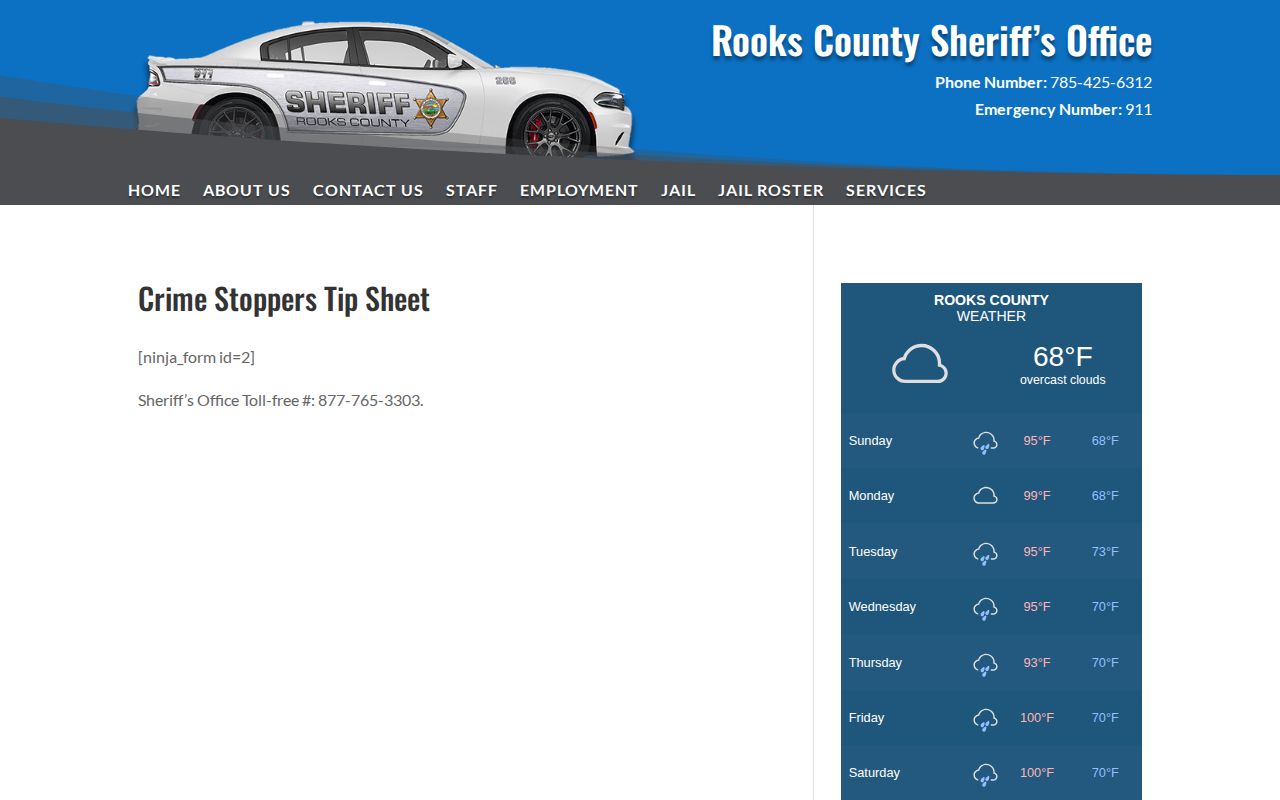
The form lets you submit a tip and nothing more. It does not back an unstated reward or an anonymity guarantee.
Rooks County Sheriff's Office803 S. Elm Street
Stockton, KS 67669
Office: 785-425-6312
Crime Stoppers: 877-765-3303
Emergency: 911
Stick to facts: location, time, vehicle description, the official notice you viewed. Do not confront, follow, photograph, or try to detain anyone.
Rooks Wanted List or Warrant
A most-wanted list is publicity, not paperwork. A warrant is different. It is a court-authorized command that can exist without any public fanfare at all. A bench warrant typically follows a missed court requirement, while an arrest warrant follows a judicial finding of legal cause. Public details on either one can be sparse. So the classification tells you less than you might hope.
| Record | What it means | Best current source |
|---|---|---|
| Most-wanted notice | A selected agency alert, if one is currently published. | Issuing agency or KBI |
| Arrest warrant | Authority to arrest based on a judicial process. | Court clerk and sheriff |
| Bench warrant | A court order often tied to failure to appear or comply. | Court clerk |
| Booking card | A custody snapshot after intake. | Official jail roster |
Legacy Rooks Warrant Pages
Rooks County once posted a large set of online warrant pages. There were roughly 438 in all. Every single one carried the same last-modified date: November 18, 2019. The pages were thin on detail. A visitor could not tell whether a warrant was still active, had been served, or had its bond terms changed.
So what do these old URLs prove? Only that the sheriff once published warrant information online. They are not a current most-wanted list for Rooks County, and treating them as a fugitive directory would misread them. A page can stay indexed in search results long after the court record behind it has changed. Search-engine dates often reflect when a page was crawled, not its legal status.
Check a Rooks County Warrant
To check a warrant in Rooks County, start with the Kansas Courts portal and the local district court. The district court office sits at 115 N. Walnut in Stockton, and its published number is 785-425-6718. A clerk can walk you through the access options. What a clerk cannot do is hand out legal advice.
- Search the person's name in the state court portal and confirm the county and case.
- Read docket events carefully. A filing date is not proof that a warrant remains outstanding.
- Contact the Rooks clerk or counsel for current process and any restricted information.
- If the matter concerns you, arrange a lawful response through counsel, the court, or the sheriff. Do not rely on a third-party page.
Some warrants stay hidden. Sealed warrants and restricted cases may never appear online, so an empty search result does not mean nothing exists. Ask the court directly when it matters.
Resolve Rooks Warrants Safely
Think a Rooks County warrant involves you? Call an attorney or the issuing court, then follow whatever official instructions they give. The aim is safe resolution, not dodging service. Court staff can point you to public filing information, and a lawyer can lay out options based on the real case.
Public Record Search
Sponsored Results